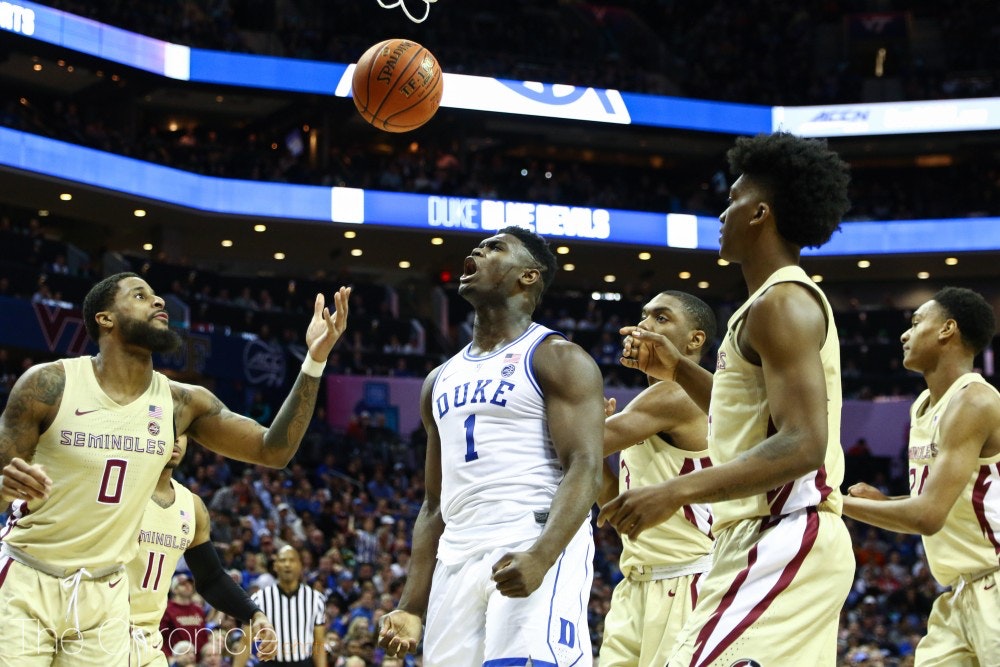
Photo Via: Duke Chronicle
The madness is upon us! Will Zion and Duke’s fabulous freshman cut down the nets? Or will Luke Maye and UNC a hybrid team full of both veterans and young stars ruin the Blue Devils Party? Can UVA bounce back? All of these questions and headlines will be answered in the tournament.
March Madness is nearly impossible to predict, hence the name “Madness”. Last Year may have been the greatest indicator of that #16 UMBC beat the #1 overall seed UVA by 20 for the first time in the tournament’s history, #13 Buffalo smacked #4 Arizona, #11 Loyola rolled past #9 K-State in the Elite 8 to make the Final 4, #7 Nevada completed a sensational comeback over #2 Cincinnati, #13 Marshall shocked the Shockers of Wichita State, there were various over shocking results from last year’s tournament.
With that being said, this NCAA Tournament Rating Index includes various subjective and objective factors. The 2 Main Components plus an adjustment for W-L% in Last 12 Games)
- A Talent Index
- My Regular Season Hybrid NCAAB Computer Ratings (Retrodictive and Predictive)
1: Talent Index:
(Weighted Avg 247 Composite Rating+* (Weighted Avg of 247 Star Rating*)+(Average Borda Count of Preseason Rankings* x .5))/3)+(Weighted Avg of Individual PERs* x 1.35)) x 2)
Weighted Avg 247 Comp. Rating= Σ (Player’s Minutes Played/(Σ of Every Player’s Minutes))*Player’s Composite Rating
Weighted Avg of 247 Star Rating= Σ (Player’s Minutes Played/(Σ of Every Player’s Minutes)) *(247 Composite Star Rating/5)
Borda Count of Preseason Rankings: ((Coaches Poll Pts Received)/(25* Number of Voters in Poll))+((AP Poll Pts Received)/(25*Number of Voters in Poll)))/2)*.5
Weighted Avg of Individual PERs: Σ (Player’s Minutes Played/(Σ of Every Player’s Minutes))*(Player’s Player Efficiency Rating))*1.35
This was indeed the subjective facet of the Index. You may be wondering why to include this at all? There have been various analyses that show talented teams often get their act together in the NCAA Tournament if they have underachieved in the regular season. There is no better example of this than 2014 Kentucky, who was preseason #1, and was chock full of Five Star Talent, but finished outside of the Top 25 and was an 8 seed going into the tournament. They then advanced through what may have been the hardest region, all the way to the National Title Game.
To measure a “Team’s Talent” is a purely subjective matter, however, there were analytics and statistics available that could at least encapsulate much of a team’s talent. The first two I used were recruiting data regarding each team’s roster. I used 247sports.com and cross-reference the players’ individual composite ratings and star ratings to the minutes’ data on https://www.sports-reference.com/cbb/. To weight player’s who played more minutes heavily. For players who did not garner a star rating or composite rating, they were assigned a .5 for their composite rating and a 0-star rating. Adjusting the recruiting ratings to the minutes played instead of using a plain ole average for the composite and star ratings was important, because otherwise, the players who were highly touted out of high school but turned out to be complete busts would increase a team’s rating much more. Through adjusting that player’s composite rating’s impact on the overall talent rating has greatly decreased. This also adjusts for the team’s who have had their 5-star players injured throughout the year like Oregon’s Bol Bol.
The third method I used to rate a team’s talent was the Average Borda Count of a Team’s Preseason Rankings in the AP Poll and Coaches Poll. At first, you may be wondering why I would use this. The reasoning mostly is based on the fact that a 30ish/35ish game regular season is not a very sufficient sample size. As FiveThirtyEight said in their employment of preseason rankings for their March Madness Predictions, “Preseason rankings provide some estimate of each team’s underlying player and coaching talent. It’s a subjective estimate, but it nevertheless adds some value, based on our research.” Again, 2014 preseason #1 Kentucky is a great example of why this can be of great assistance. To calculate these I used a Borda Count which is simply the amount of points received divided by the max points received, and in the polls the max points is recieved is just the # of Voters multiplied by 25. I also included teams who received votes but did not make the Top 25, in the Borda Counts. Teams who did not receive any preseason votes were assigned a 0, and to adjust for greater variation in this metric I multiplied it by .5 to level the standard deviations between this facet and the others.
The last method I used for approximating a team’s talent was Player Efficiency Rating. PER is a lengthy and complicated box score efficiency metric made by John Hollinger. Being an efficiency metric means that it is roughly based on a per minute basis. To adjust for this I used the same method I used for the Recruiting Ratings, and multiplied it by the % of Minutes Played, then summed it up. I used PER because this allows us to gain insight into players who may not have been the most highly recruited but have had great regular season performances. Some notable examples of this are the unrated Ja Morant of Murray State, 3* Brandon Clarke of Gonzaga, 3* Jarett Culver of Texas Tech, and 3* Ethan Happ of Wisconsin.
The calculations behind combining these different facets are mentioned above.
Part 2: Predictive and Retrodictive Hybrid Rating
Team Computer Rating: (W-L%)+(Strength of Schedule* x 1.5)+((.01 xAdj Net Rating*)+(.01 x Adjusted Scoring Margin* x 1.75)) x 1.35))/3
Strength of Schedule: (2/3 * Opponents W-L%)+(1/3 * Opponent’s Opponents’ W-L%)
Adjusted Net Rating: 100*(Pts-Opp Pts)/Poss), Then it is adjusted for the opponent’s average Adjusted Net Rating in an iterative processs.
Adjusted Scoring Margin: (Pts-Opp Pts)/(Games Played), Then it is adjusted for the opponent’s average Adjusted Net Rating in an iterative process.
Via: Sports Reference
The second facet of my index was a rating system for teams that combined retrodictive aspects and predictive aspects into one. It is quite similar to the ratings I have done for other sports, such as my NBA Metric. The Adjusted Net Ratings and Adjusted Scoring Margins were calculated by https://www.sports-reference.com/cbb/.
One thing you may notice is that I assign more importance to the scoring margin and net rating metrics than I normally do, this is because I made this index with the intent of predicting March Madness Games, and scoring margin metrics tend to be more predictive in nature.
Lastly, I added an adjustment for W-L% in Last 12 Games.
Therefore the Final Formula was:
((W-L% in Last 12 x .01)+(Talent Rating x .3)+(Computer Rating x .7)
The Ratings:
Here is a bracket using the metric:


 Tyler's Basic Sports Metrics